Scenario Briefing
The Martian
You are the only human on a planet that is trying to kill you in every way it knows how — and you are going to science the hell out of this.
360° world view
Render an immersive panorama of this world. One-time generation, cached for every visitor.
Before You Begin
NASA astronaut, botanist, and mechanical engineer stranded on Mars
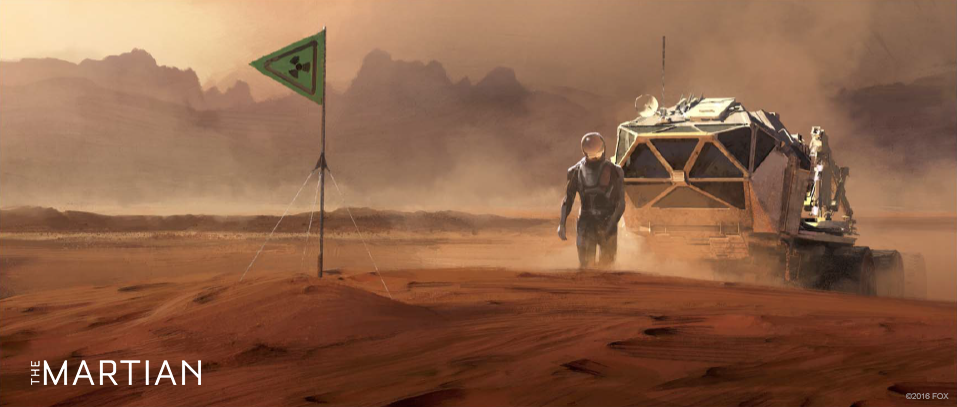
You are Mark Watney, PhD in botany, cross-trained in mechanical engineering, the lowest-ranked member of the Ares 3 crew and now the sole inhabitant of an entire planet. During an emergency evacuation in a dust storm on Sol 6, an antenna tore loose and impaled you through the abdomen. Your bio-monitor flatlined from the antenna piercing the device. Your crew, unable to find you in the storm, made the right call and launched without you. You woke up face-down in Martian sand with a hole in your suit and a hole in your side and nothing but your training, your tools, and an aggressive refusal to die quietly.
The Situation
Mars is a world that hates you personally. The atmosphere is 95% carbon dioxide at less than 1% of Earth's pressure — step outside without a suit and your blood boils in your veins. The soil is full of perchlorates that will poison any plant that touches it. The average temperature would kill you faster than Antarctica. There is no liquid water, no breathable air, no food chain, no rescue for at least four years. Acidalia Planitia is a vast basalt plain chosen for the Ares 3 landing because it is flat, geologically boring, and near the equator — maximum solar panel efficiency. The Hab is a canvas-and-aluminum dome designed to sustain six astronauts for thirty days. The MAV — Mars Ascent Vehicle — was supposed to launch the crew back to orbit on Sol 31. It launched on Sol 6, in a dust storm, without you. The crew thought you were dead. You are not dead. You are alone on Mars with enough food for three hundred sols, a Hab that was not built for long-term habitation, a rover with limited battery range, and every single thing you learned in your PhD in botany and your engineering cross-training. The next Ares mission arrives in four years. The math is not in your favor. But math is just a problem, and you solve problems.
Your Objectives
Survive on Mars long enough for rescue — approximately 1400 sols until the next mission arrives
Establish communication with NASA so they know you're alive
Grow enough food to supplement your limited rations and avoid starvation
The Cast
6 charactersPlaystyle Profile
Reviews
No review yet?
Be the first to share your thoughts on this scenario.
Quick Facts
- Era
- Sol 6, Ares 3 Mission — 2035, when NASA has landed humans on Mars for the third time, this time in the flat basalt plains of Acidalia Planitia, where the wind never stops and the temperature drops to minus 70 Celsius at night.
- Location
- Acidalia Planitia, Mars
- Starting Position
- The Hab
- Playable Leader
- Mark Watney
- Game Systems
- Sci-fi, Survival, Adventure