Scenario Briefing
The Front Line
The story that could stop a war — if you can get it out alive.
360° world view
Render an immersive panorama of this world. One-time generation, cached for every visitor.
Before You Begin
Senior war correspondent for a major international news network, covering the Karvina civil war with ten years of conflict zone experience and a story that could change international intervention
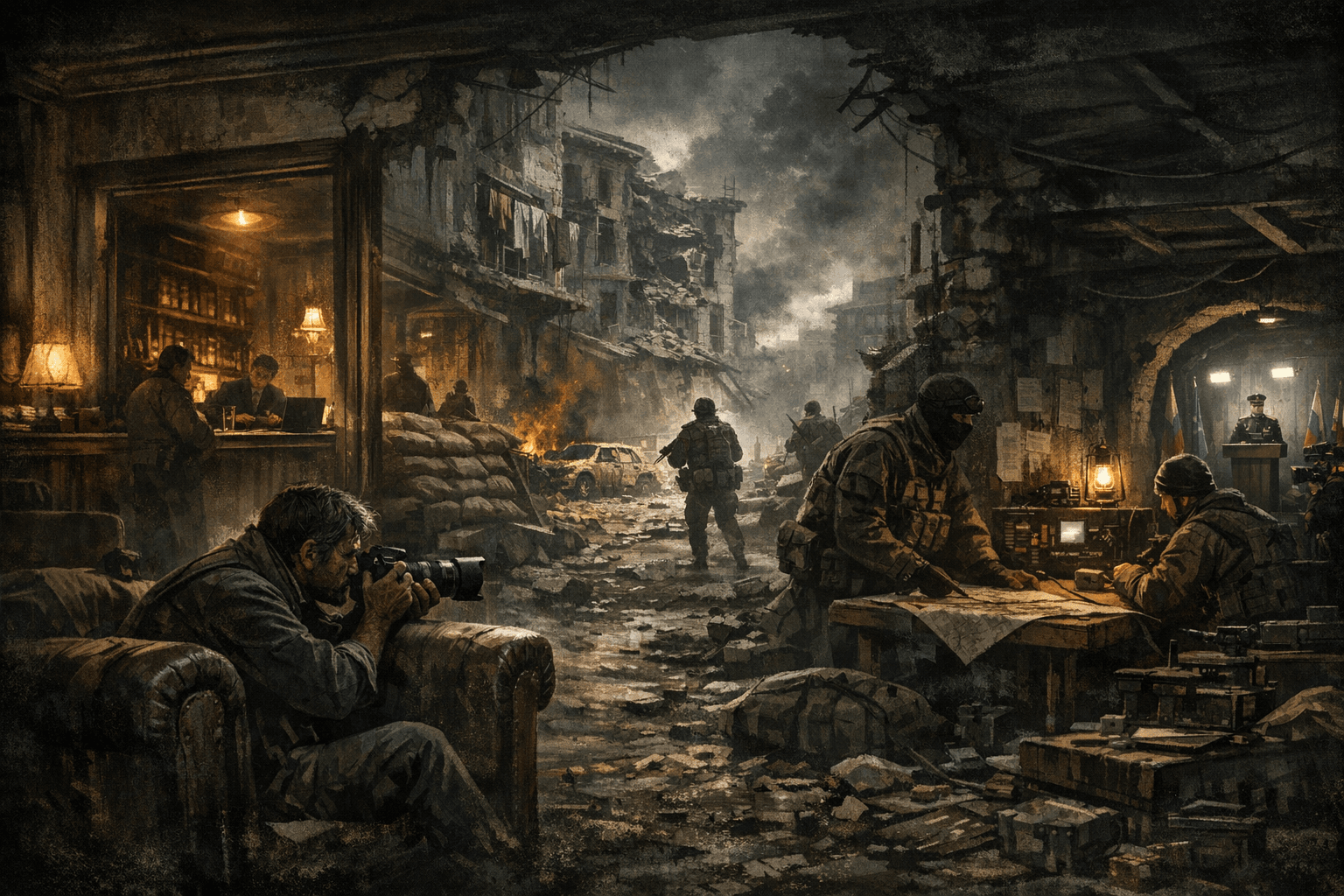
You have spent ten years covering the worst things human beings do to each other and calling it a career. Mogadishu, Aleppo, Mariupol, Tigray — your byline has appeared over stories that made people put down their coffee and read. You have won awards for work that did not change anything and filed stories that changed everything without winning anything. You know the difference between a war and a story about a war, and you have spent a decade trying to close that gap. Karvina is your eleventh conflict zone. You arrived three hours ago on the last commercial flight that was willing to land at Vasovic airport, which means you are here until someone flies you out or you drive to the border. Your fixer, Mira, met you at the hotel with a look that said things have deteriorated since your last call. Your photographer, Tarik, is already here — he came in overland two days ago because the flights were cancelled and he does not wait for flights. Your editor, Margaret, wants the story. Your network wants ratings. The government wants you to report their version. The rebels want you to report theirs. And somewhere in this city, in the rubble of a school that should never have been bombed, there is evidence that could make the world pay attention. The hard part is not finding the story. The hard part is getting it out alive and getting it right.
The Situation
Karvina is a small Eastern European country wedged between larger powers that have historically treated it as a buffer state. For forty years after independence, it held together through a fragile coalition government balancing the ethnic Karvinan majority in the west and the Rusyn minority in the east. That coalition collapsed eighteen months ago when President Drasko Lazarevic dissolved parliament, arrested opposition leaders, and declared emergency rule. The eastern provinces revolted. What began as protests became an armed separatist movement — the Rusyn Liberation Front — supplied by sympathizers across the border and led by commanders who learned to fight in other people's wars. The government responded with overwhelming force. Three months ago, the front line reached the capital, Vasovic. The city is now divided: government forces hold the center and west, the RLF holds pockets in the eastern districts, and a no-man's-land of destroyed neighborhoods separates them. Civilians are trapped on both sides. The international community has issued statements and imposed sanctions that have accomplished nothing. A UN ceasefire resolution is stalled in committee. Humanitarian corridors exist on paper but not in practice. Foreign journalists are technically permitted but practically controlled — the government issues media credentials that can be revoked at any time, and the rebels trust no one who arrives through official channels. The story the world is getting is the government's story. The story the world needs is something else entirely. You are here to find it.
Your Objectives
Get the school bombing story — evidence of a government war crime — reported with enough proof to survive denial and trigger international response
Protect your sources, particularly the civilian witnesses and your fixer, whose safety depends on your discretion
Navigate between government control, rebel desperation, editorial pressure, and rival competition to file a story that is both true and impactful
The Cast
11 charactersPlaystyle Profile
Reviews
No review yet?
Be the first to share your thoughts on this scenario.
Quick Facts
- Era
- March 2026, three months into the siege of the capital
- Location
- Karvina — A Country Tearing Itself Apart
- Factions
- Karvinan Government Forces vs Rusyn Liberation Front (RLF) vs International Press Corps
- Starting Position
- Press Hotel
- Playable Leader
- Senior war correspondent for a major international news network, covering the Karvina civil war with ten years of conflict zone experience and a story that could change international intervention
- Game Systems
- Thriller, Drama, Political