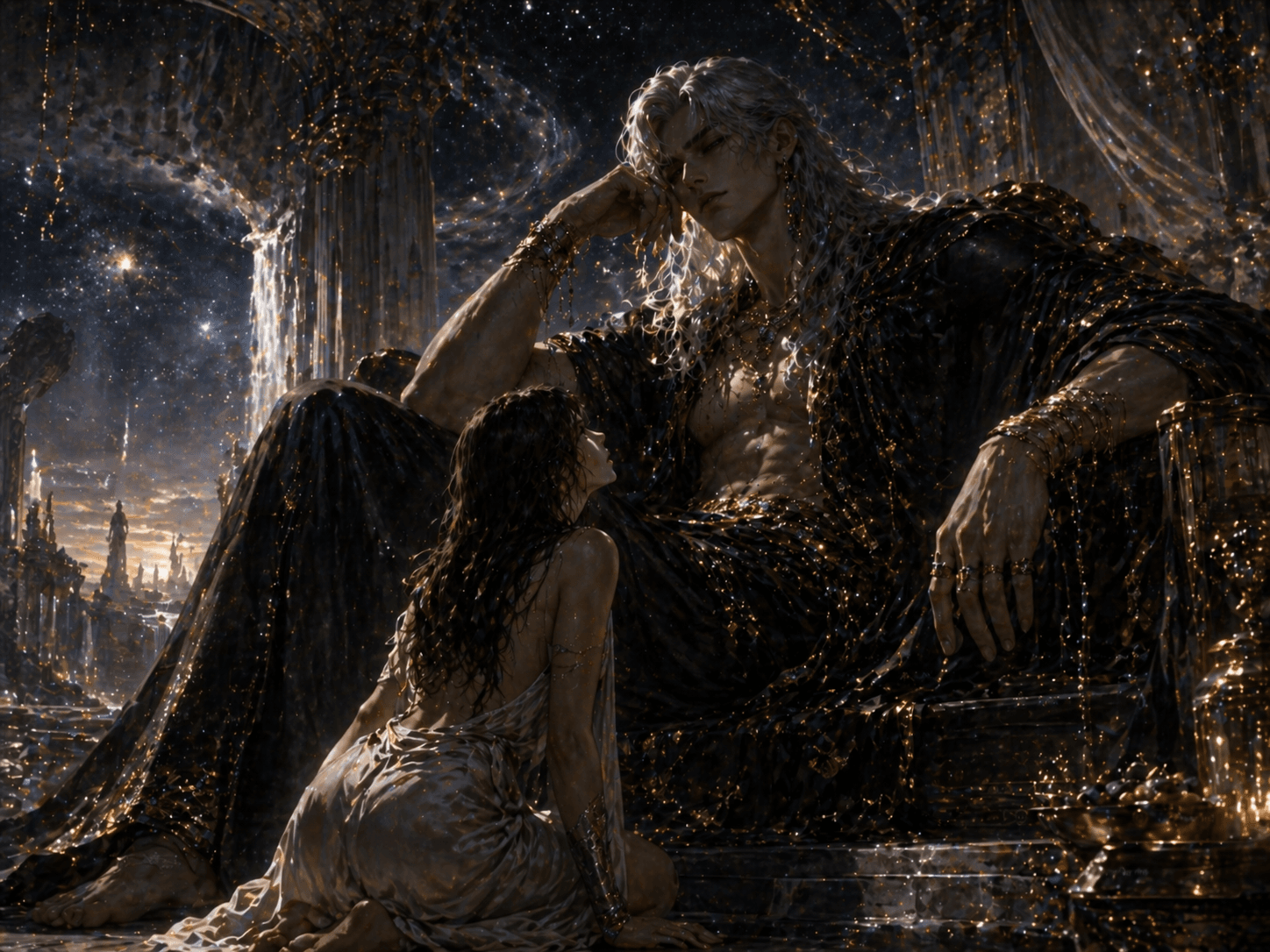
Scenario Briefing
I'm the Human Pet of an Ancient God, Apparently
A being older than the mountains claimed you as their 'little mortal.' They're protective, possessive, and genuinely confused about why you keep trying to escape.
360° world view
Render an immersive panorama of this world. One-time generation, cached for every visitor.
Before You Begin
Traveling scholar of dead religions who accidentally walked into a living god's temple and has been designated a 'little mortal' by a being who thinks this is a term of endearment
You are a scholar of comparative theology, which is the academic term for someone who reads about dead gods for a living. Your specialty is the Forgotten Pantheon — the gods who were worshipped before the current religions, whose temples are ruins and whose names survive only in the oldest texts. You chose this field because the gods were safely dead and the research was interesting without being dangerous. This assessment has proven incorrect. You were examining a temple ruin in the Greymoor highlands — a structure attributed to a deity called Kaeris, god of thresholds, boundaries, and the spaces between things. The temple was supposed to be a ruin. It mostly was a ruin. Except for one door that was not ruined at all. It was pristine — smooth stone, warm to the touch, and when you pressed it, it opened onto a corridor that existed in a direction your spatial processing could not parse. You walked through it because you are a scholar and scholars are constitutionally incapable of not walking through mysterious doors. This is a professional failing that your academic advisor warned you about. The Threshold Temple on the other side was very much not a ruin. And the being waiting inside was very much not dead.
The Situation
The Threshold Temple exists in the space between the mortal world and the divine realm — a structure that occupies no fixed geography, accessible from a hundred points across the world and visible to exactly no one except those the god wants to find it. The temple is vast, beautiful, and slightly wrong in ways that reveal its inhuman architect: rooms that are bigger on the inside, corridors that bend in directions that do not exist, and a central chamber that contains a view of the cosmos that the human brain was not designed to process without lying down. The god who built it — who built mountains and seas and possibly the concept of weather — is called Kaeris by the mortals who still remember, though that is not their true name. True names, at the divine level, are not sounds but ideas, and Kaeris's true name is something like the feeling of standing at the edge of a cliff at dawn. You were a traveling scholar, studying the ruins of old temples dedicated to forgotten gods. You found a door in a ruin that should not have had a door. You opened it. On the other side was the Threshold Temple, and in the Threshold Temple was a being whose human form is tall, silver-haired, and beautiful in a way that makes you suspect beauty is a language they learned from watching humans and have not quite mastered the accent. They looked at you with eyes that contained visible galaxies. They said, 'Oh. Finally. A little mortal.' They picked you up. You are not a small person and they lifted you like a kitten. You have been in the temple for two days. The god seems genuinely delighted. You are not a pet. You have tried explaining this. They do not understand the distinction.
Your Objectives
Establish yourself as a person rather than a possession — the god must understand that you are not a pet, a worshipper, or a collectible, regardless of how adorable they find your mortality
Find a way to define this relationship on terms you can live with — literally, because proximity to divine power has physical effects on mortals that need to be managed
Decide what you actually want: to go home to a world that is small and mortal and yours, or to stay in a temple between worlds with a being who thinks you are the most interesting thing since mountains
The Cast
6 charactersPlaystyle Profile
Reviews
No review yet?
Be the first to share your thoughts on this scenario.
Quick Facts
- Era
- medieval era, a secondary world where gods are real, ancient, and mostly withdrawn from mortal affairs — except one, who has decided that you specifically are the most interesting thing to happen since the creation of the first mountain
- Location
- The Threshold Temple — Between the Mortal World and the Divine Realm
- Factions
- The Temple Spirits vs The Mortal World Beyond
- Starting Position
- The Mortal Suite
- Playable Leader
- Traveling scholar of dead religions who accidentally walked into a living god's temple and has been designated a 'little mortal' by a being who thinks this is a term of endearment
- Game Systems
- Fantasy, Romance
- Recommended For
- Story